1. Introduction
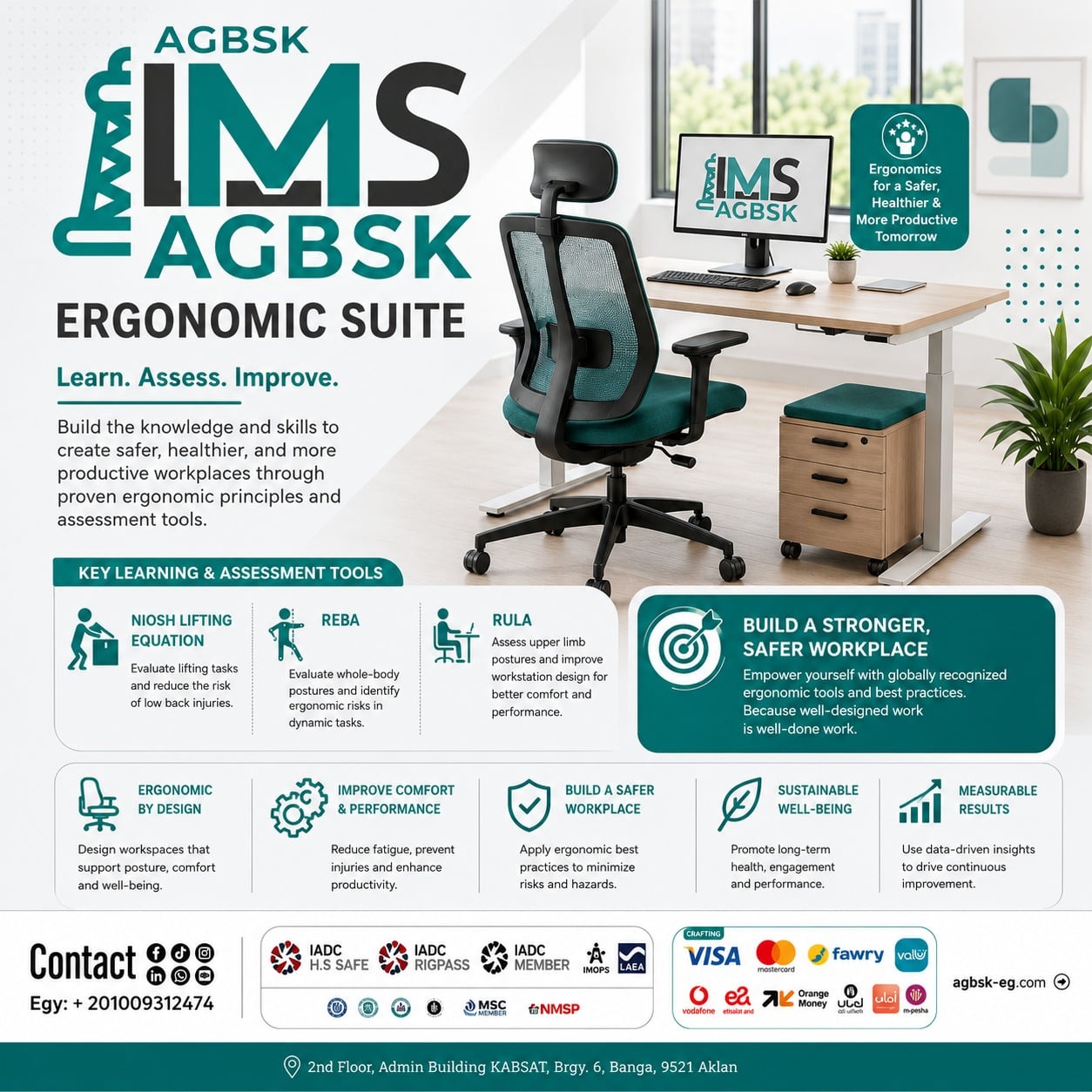
The AGBSK Ergonomics Assessment Suite is a professional-grade, interactive digital tool developed by AGBSK Engineering, Drilling & Safety Services. It is designed to support HSE professionals, occupational health practitioners, and safety engineers in conducting rigorous, evidence-based ergonomics assessments at the workplace.
The suite consolidates three internationally recognised ergonomics assessment methodologies into a single, guided application — the NIOSH Revised Lifting Equation (1994), the Rapid Entire Body Assessment (REBA), and the Rapid Upper Limb Assessment (RULA). Each tool is presented with step-by-step scoring, illustrated SVG diagrams, real-time risk classification, and a printable assessment report.
Developed by certified safety professionals holding credentials including CSP, CIH, ASP, and CMIOSH, and produced under the accreditation standards maintained by AGBSK — including IADC, LEEA, DROPS, ISO, NASP, and BCSP — the suite reflects the organisation’s commitment to equipping the safety community with practical, reliable tools grounded in current occupational safety science.
2. Purpose and Learning Objectives
The primary purpose of the AGBSK Ergonomics Assessment Suite is to bridge the gap between ergonomics theory and field practice. Many safety professionals are familiar with the principles of NIOSH, REBA, and RULA assessments from academic study or professional examination preparation, but lack access to an integrated, practical tool for applying these methods in the workplace.
The suite is designed to achieve the following learning and professional objectives:
2.1 Knowledge Application
- Enable practitioners to apply the 1994 NIOSH Revised Lifting Equation correctly, including calculation of all six task multipliers and interpretation of the Recommended Weight Limit (RWL) and Lifting Index (LI).
- Guide users through the REBA scoring process for full-body postural risk assessment, from raw observation to action level determination.
- Support accurate completion of RULA assessments for upper extremity risk, including grand score table lookup and muscle use adjustment.
2.2 Skill Development
- Develop the ability to identify high-risk manual handling tasks and postural hazards through structured, illustrated assessment.
- Build competency in translating assessment scores into actionable ergonomic interventions with appropriate priority.
- Reinforce understanding of biomechanical principles underlying musculoskeletal disorder (MSD) risk in the workplace.
2.3 Professional Examination Preparation
- Support candidates preparing for the BCSP Certified Safety Professional (CSP), Associate Safety Professional (ASP), and Board of Certified Industrial Hygienists (CIH) examinations, for which ergonomics assessment competency is a tested domain.
- Provide an interactive reference tool for reviewing and reinforcing assessment methodology between study sessions.
3. Assessment Tools Included
3.1 NIOSH Revised Lifting Equation
The National Institute for Occupational Safety and Health (NIOSH) Revised Lifting Equation is the internationally accepted standard for evaluating manual lifting tasks and determining whether a task poses an unacceptable risk of low back injury.
The tool calculates two primary output values:
- Recommended Weight Limit (RWL) — the maximum weight that can be safely lifted by 75% of the working population under the specified task conditions.
- Lifting Index (LI) — the ratio of the actual object weight to the RWL, used to classify risk level.
The six task multipliers used in the calculation are:
Code | Multiplier | Definition |
HM | Horizontal Multiplier | Penalises increased horizontal distance between the hands and the body’s mid-point. Optimal value: 25 cm. |
VM | Vertical Multiplier | Penalises deviation of hand height from the optimal knuckle height of 75 cm above the floor. |
DM | Distance Multiplier | Accounts for the vertical travel distance of the load during the lift. Optimal: minimum vertical travel. |
AM | Asymmetry Multiplier | Penalises body twist from the sagittal plane at origin or destination. Optimal: zero degrees of rotation. |
FM | Frequency Multiplier | Adjusts for lift frequency per minute and duration of lifting task. Optimal: infrequent, short-duration lifting. |
CM | Coupling Multiplier | Accounts for grip quality — good, fair, or poor coupling with the object being lifted. |
Risk Classification by Lifting Index:
Lifting Index | Risk Level | Required Action |
LI <= 1.0 | Acceptable | Task is within safe limits for the majority of workers. Maintain and monitor. |
LI 1.0 – 2.0 | Moderate Risk | Some workers may be at risk. Engineering or administrative controls should be considered. |
LI 2.0 – 3.0 | High Risk | Most workers are at elevated risk. Task redesign is strongly recommended. |
LI > 3.0 | Very High Risk | Task is hazardous. Immediate intervention is required. Consider mechanical lifting assistance. |
3.2 REBA — Rapid Entire Body Assessment
REBA is a widely used, observational whole-body postural risk assessment tool developed by Hignett and McAtamney (2000). It is particularly suited to dynamic, unpredictable tasks involving the entire musculoskeletal system — such as patient handling, construction, and manual material handling in industrial settings.
The REBA assessment evaluates two groups of body regions:
- Group A — Neck, Trunk, and Legs: scored for flexion, extension, and lateral deviation, with additional modifiers for twisting and leg loading.
- Group B — Upper Arm, Lower Arm, and Wrist: scored for flexion angle and deviation, with modifiers for shoulder abduction and wrist bending.
- Scores from Group A and Group B are combined using the REBA lookup tables (Table A, Table B, Table C), with adjustments for load and force, coupling, and activity level.
REBA Action Levels:
Score | Risk Level | Action Level | Recommended Response |
1 | Negligible | Level 0 | No action required. |
2 – 3 | Low | Level 1 | Change may be needed. Review at next scheduled audit. |
4 – 7 | Medium | Level 2 | Further investigation required. Implement controls soon. |
8 – 10 | High | Level 3 | Investigate and implement changes promptly. |
11 – 15 | Very High | Level 4 | Implement changes immediately. Risk is unacceptable. |
3.3 RULA — Rapid Upper Limb Assessment
RULA is a posture-based risk assessment tool developed by McAtamney and Corlett (1993), specifically designed to evaluate the risk of work-related upper limb disorders (WRULDs) in tasks involving sedentary or repetitive upper extremity work — such as office tasks, laboratory work, assembly line operations, and inspection tasks.
- Group A (Upper Limb): Upper arm position, lower arm flexion, wrist deviation, and wrist twist.
- Group B (Neck, Trunk, Legs): Neck flexion and extension, trunk inclination, and leg support.
- Scores from both groups are combined using the RULA grand score table, with adjustments for muscle use and force applied.
- Final scores range from 1 to 7, corresponding to four action levels from acceptable posture to immediate intervention required.
4. Target Audience
The AGBSK Ergonomics Assessment Suite is designed for a broad range of occupational safety and health professionals, as well as students and examination candidates in the field.
Audience | Application |
HSE Engineers and Managers | Conducting formal ergonomics risk assessments as part of workplace safety management systems. |
Occupational Health Professionals | Identifying musculoskeletal disorder risks and recommending clinical or engineering interventions. |
Industrial Hygienists (CIH / IH) | Applying quantitative ergonomic assessment tools as part of a comprehensive occupational hygiene programme. |
Safety Officers — Oil, Gas & Drilling | Assessing manual handling tasks in high-risk environments including rigs, platforms, and construction sites. |
Ergonomics Consultants | Delivering client assessments with a standardised, auditable methodology and professional report output. |
CSP, ASP, and CIH Candidates | Reinforcing ergonomics assessment competency for professional certification examination preparation. |
University Students — OSH Programmes | Applying theoretical ergonomics knowledge to practical assessment scenarios as part of coursework. |
Training Coordinators | Delivering ergonomics awareness training with interactive demonstrations and assessment exercises. |
5. Benefits
5.1 For Individual Professionals
- Eliminates the need for paper-based worksheets, complex spreadsheets, or expensive proprietary ergonomics software.
- Provides an illustrated, guided workflow that reduces scoring errors and improves consistency across assessments.
- Generates a professional report output suitable for formal documentation and client delivery.
- Works in any environment — online or offline — including remote industrial sites with restricted internet access.
- Free of charge for registered professionals — lowering the barrier to high-quality ergonomic assessment capability.
5.2 For Organizations
- Standardizes ergonomics assessment methodology across HSE teams, reducing variability and improving audit quality.
- Supports compliance with occupational health and safety legislation requiring documented ergonomic risk assessment.
- Enables rapid identification of high-priority musculoskeletal hazards, supporting targeted intervention and resource allocation.
- Provides a training tool for developing internal ergonomics assessment competency within HSE departments.
- Aligns with international standards and frameworks including ISO 9241, OSHA ergonomics guidance, and NIOSH technical reports.
5.3 For the Safety Community
- Promotes evidence-based ergonomics practice across the MENA region, where access to dedicated ergonomics tools has historically been limited.
- Supports professional development and continuing education for HSE practitioners at all career stages.
- Contributes to the broader goal of reducing work-related musculoskeletal disorders, which represent one of the leading categories of occupational injury and illness globally.
Course Content
AGBSK_Ergonomics_Suite_Open
-
Test Your Self
Earn a certificate
Add this certificate to your resume to demonstrate your skills & increase your chances of getting noticed.

 Lessons: